Infrared Training Center

Showing posts with label Thermal Imager. Show all posts

Thursday, September 7, 2017

IR finds Yellow Jackets Nest in House

by Sanin Mulic, Barber Foods

After attending my level one instruction during the week, and ITC wetting my appetite for thermal imaging, I returned home with my company's P-65 camera.  I decided to scan my own house to practice what I was taught all week.  All looked good until I went upstairs and noticed a bright spot on the inside wall.  I took several images of the spot and come Monday, I talked to two level 2 associates about what I had found.  There were several possibilities and I was told to take several more shots at different times to see if it moved or varied in temperature.   When we found it never moved I suggested that it might be insects (wasps, hornets, etc.) and talked with one of the other thermographers who would bring in a stethoscope to see if  I could hear them before opening up the wall.
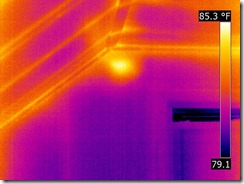
Wasps  Wasps-vis 
Thermal image of the wasp nest (left).

I couldn’t wait, so that night armed with a drill, a can of flying insect killer, and the enthusiasm of a new thermographer,  I went up to the room; my pet cat, who loves to lay in the window there, had to investigate with me too.   I approximated where the hotspot was and drilled a 1/8 “ hole through the wall board. As I removed the drill bit, about 8 to 10 yellow jackets came charging through the hole and I started to spray the bug spray at the hole.  By this time, the yellow jackets were in an attack mode and I started to swing at them in defense.  Out of the corner of my eye I saw my cat speeding to the door with his tail bigger than I have ever seen it.  I finally killed the last one, sprayed about 1/3 of the can, and plugged the hole; but not before being stung twice.  I went outside and saw a swarm just outside the window. I drilled a second hole a few inches above it and knowing what was going to follow,  I had the spray ready to go as soon as the drill came out.  I sprayed about 1/3 of the can and then plugged the hole. I returned several hours later and the swarm was gone.  I climbed a ladder and found a small hole where they were coming and going.  I plugged that from the outside.  As I came back inside I saw my cat peaking from around the door as if to ask “Is it safe to come out now?”

After a few days I took another thermal image and there was no evidence of the yellow jackets remaining.  I submitted this investigation as my level one field report and it passed, but the memory of this initial experience will last a long time (the cat won’t forget it either!)
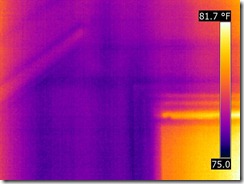
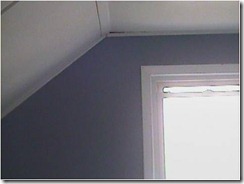
No-wasps no-wasps-vis
No wasps after removal.

Monday, November 2, 2015

The Shadow Man Cometh

By Ronald Lucier, ASNT NDT Level III, Infrared Training Center

When I use the term “Radiation Heat Transfer” in my classes I sometimes get puzzled or even frightened looks as some folks associate the term radiation to Chernobyl and atomic weapons. It takes only a few minutes and a couple demonstrations to put them at ease though.

One of the simpler demonstrations is done outdoors on a sunny, warm day. It is common knowledge that the Sun is HOT – roughly 6000 ˚C or 10800 ˚F. Happily the Inverse Square Law and our atmosphere attenuate the thermal radiation to livable levels here on Earth!

But it is still thermal radiation! What happens if we interrupt that radiation? A simple experiment is to take a thermal camera into a safe area, like a parking lot, and create your own shadow!

I did this in the middle of my street the other day. Fortunately we don’t get much traffic, usually only the postman drives by and that’s to turn around and deliver mail.

Setting my camera up (a FLIR T650sc) to record a radiometric .csq file, I started recording and walked into the scene and made a shadow. The change in roadway temperature WAS INSTANTANEOUS! After 30 plus years in the business we sometimes get surprised and I was! Look at the raw plot data, ignore the spikes and where I walked into the scene:

fig 1

The two spots started out at the same temperature. Just look at the table data.

Time (sec)

Roadway

Shadow

Difference

0:00

98.2

98.3

0.1

9.37

98.9

98.5

-0.5

14.77

99.1

97.7

-1.4

22.2

99.4

97.2

-2.2

29.8

99.7

97.1

-2.6

50.13

99.9

96.1

-3.8

61.6

100.0

95.5

-4.5

67.3

100.0

95.4

-4.6

All temperatures are in degrees Fahrenheit.I stopped taking data at 67 seconds as it was indeed a partly cloudy day and the clouds came by. Here are my start, middle and end jpegs:

image image image

Engineers love graphs so I can’t resist! I took five seconds of data and drew a trend line through both sets to show that the roadway wasn’t cooling, just the shadow.

image

This doesn’t require a high end camera such as the FLIR T650sc – any IR camera, a little Sun, an absorbing surface such as a sidewalk or even a wall will suffice.

The best way to learn is to teach! I encourage all the readers of this article to go teach your friends, co-workers and family a little bit about radiation heat transfer!

Wednesday, July 8, 2015

New Online Course: FLIR Cx Operation Basics

This course will introduce you to the operation of the FLIR Cx infrared camera. This course is a self paced on-demand web course, you can start as soon as you enroll and you can stop and continue where you left off at any time. There is NO CHARGE for course.
We will discuss the controls of the camera as well as the user interface, and show you how to operate your camera and your report and analysis software.

Who should take this course: This course is intended for users of the FLIR Cx camera or anyone interested in purchasing one.

Prerequisites: No prior knowledge of thermography or infrared cameras is assumed.

Availability: This course is an on-demand self paced web based training course available 24 hours a day, 7 days a week. You can begin as soon as you enroll.

Course Homepage

Monday, April 13, 2015

ThermalSpeak – building efficiency and thermal bridging

by Jay Bowen
BPI Energy Analyst
ASNT NDT Level 3 Thermographer

Building conversations in training this week brought up the subject of thermal bridging in the structure. Defined by a material of less insulation or greater conductivity. This material bridges or short circuits the better insulation and reduces its effectiveness. This reduces the overall R value rating of the whole assembly. The following website,  http://web.ornl.gov/sci/roofs+walls/AWT/home.htm , addresses this whole wall rating concept. This isn’t a debate of test methods or approaches. It is enough to say that anything put in the wall that reduces the energy of that wall should be addressed in the construction process.

My input on this subject is finding these, before construction begins and discussion with a builder, methods to reduce or eliminate these bridges. Verification of the design or confirmation as building progresses would be where a thermographer can enter the process and provide proof that the building project has conformed to this concept of design.

The images from a qualified thermographer provide detailed analysis of construction detail typically hidden from the inspectors or builders.

Taking a set of images to compare this approach can clearly see the advantage of reducing the vertical framing typical of stick built construction. Even the wide wall of 2x6 framing to increase the side wall dimensions for increased insulation. This is an increase in the R value but the thermal bypass of the stud is still there.

Jay1

jay2

Using SIP to reduce bridging

Standard stick frame wall

Looking at a SIP wall can visualize the reduction in the bypasses by reducing the vertical framing. The corners and joints are still present but can be reduced by the same methods of stick built using exterior insulated sheathing.

Making the bridge elimination or reduction a conscious thought in the whole building process can have substantial rewards in energy saving in the home.

Thursday, November 6, 2014

Throwback Thursday – AGA Thermovision 651

IMG_3099While at FLIR Systems in Täby, Sweden last week for the ITC User Conference, I came across this on display in the main lobby that I just had to share as a “Throwback Thursday” item.  It’s an AGA Thermovision 651, the world’s first commercial infrared system from the mid-1960s.

The device used liquid nitrogen to cool the detector and worked with a display that was a modified oscilloscope. The camera had a field of view of 5˚ x 5˚, a thermal sensitivity of 0.2˚C (0.36˚F) and a frame rate of 16 Hz.  Total weight, including all necessary accessories (tripod, oscilloscope, etc.) exceeded 110lbs (50kg)!

Thermal imagers certainly have come a long way since then, but having the chance to see this in person really makes me appreciate what we have for options in the marketplace today.

IMG_3102 IMG_3100

Friday, October 10, 2014

Best of InfraMation Live Webcast: Cold Air in Boston

Thursday, December 18thcold-air-boston-sawyer-IR-thumb-jpeg

2:00 p.m. EST (-5 UTC)

Guest Presenter – Dave Sawyer

Click Here for FREE Registration

Originally presented at InfraMation 2010, Dave Sawyer of Sawyer Infrared returns for a special live webinar to present his paper from the conference proceedings. It features two case studies involving clients of his from the Boston area who dealt with building performance issues.

One was an upscale restaurant experiencing cold air infiltration that was caused patron discomfort and increasing heating costs for the owners. The other, a large grocery store, was concerned that a number of freezers situated outside the building might be losing precious cold air. In both instances, thermal imaging revealed problems that would not have been detected with other test methods.

To register for this and other free live webcasts from ITC, please visit: www.infraredtraining.com/webinars

Friday, September 12, 2014

An ITC Hot Spot: Focus (Video)

In a previous ITC Hot Spot we discussed the impact that Thermal Capacitance has on thermographers.  Now, this first video in a series of segments that we’re producing on image quality, we address focus and how it can negatively affect our ability to discern important thermal details and measure accurate temperatures if not adjusted properly:

Tuesday, May 27, 2014

Infrared Everywhere: Hot Chicks

After I joined the ITC team this past fall, my family and I have been caught up in the process of relocating to southern New Hampshire. Now that we’re finally settled in, and the last of the moving boxes have been emptied, I guess it was time to take on another challenge, this one involving fresh eggs. My wife has always wanted to try raising chickens, and now that we live on a small farm, what better place to take the plunge!

The little ladies arrived in the mail about five weeks ago (yes, the Post Office delivers chicks) and have been growing rapidly ever since. Here’s a quick infrared video from their first week inside the house, captured with a FLIR T650 thermal imager:

Monday, February 10, 2014

Can the FLIR One™ Personal Thermal Imager Perform Real Work?

I have seen some buzz around the internet about the FLIR One’s ability to do serious infrared work.  While it is a low resolution thermal imager, the combination of its IR imaging and FLIR’s MSX technology makes it into a useful tool.

Take a look at the following FLIR One™ images of thermal anomalies found in a house, and see if you don’t agree.

Missing Insulation 
Missing Insulation

Cold air leaking around outlet

Cold air leaking through a vent 
Cold air leaking through a vent

Drain Pipe in Wall 
Drain pipe in wall

Friday, January 10, 2014

New Online Course: FLIR K Series Basics


A tutorial on the basic operation of FLIR K Series Infrared Cameras for Fire Fighters in English, French, and German. This course is offered at no charge.
Course Homepage

Thursday, September 13, 2012

New Online Course Released - Introduction to Thermography for Home Inspectors

Are you a home inspector interested in adding infrared thermography to your list of services? Do you already own an infrared camera and want to learn where and how it can be used for home inspections? Then this course is for you!
We start out with just enough "science" to get you into the groove, then its on to applications: why they work, how to do it, and case history examples. The course is divided into the following sections:
  • Thermography Basics
  • Moisture Investigations
  • HVAC Investigations
  • Insulation Investigations
  • Air Leakage Investigations
  • Electrical Investigations
  • Structural Investigations
  • Miscellaneous Investigations
Use this link to go to the course home page for more information.

Tuesday, June 5, 2012

IR Cost Savings for Seam Welder PM’s

by Steven Noel
Reliability Engineer / Group Leader
Batesville Casket Co.

The Batesville Casket Assembly Plant located in Batesville, Indiana has two Seam Welders in their fabrication department. These Seam Welders are resistance welders that are designed to weld a continuous weld that holds the casket bottoms in place while making an air tight seal. Each Seam Welder runs proximity 27 units each hour and is in use for up to 10 hours each day throughout the week.

clip_image002

When a seam welder starts failing due to insulation failure you start seeing poor welds which in some cases don’t show up until the unit is built and vacuum tested prior to ship out. At this point to make repairs to the casket is costly due to disassembly and removal of the interior to gain access to the bottom.

Furthermore if one of the Seam Welders were to fail during production it would reduce production by 50%. The lead time for making this type of repair is two to three hours causing production losses estimated at eight to ten thousand dollars.

These Seam Welders are 16 volt DC / 20,000 amp resistance welders so being very low voltage and high amperage any insulation breakdown will cause the foot and lower wheel to overheat and eventually fail.

Wednesday, February 8, 2012

Measuring Body Temperature with an Infrared Camera

by Mikael Cronholm and Gary Orlove

From a biological standpoint, human beings are so called warm blooded animals. That means that we maintain a fairly constant body temperature, regardless of the surrounding temperature. The term body temperature (that we compare with when we decide whether a person has a fever or not) refers to the inside temperature, or core temperature of the body. The outside of the body is nearly always colder. It must be, because as we convert the energy from our food when we do work, we also produce heat. That heat has to go somewhere and if the outside and inside temperatures were the same, no heat transfer would be occurring.

None of us have a constant metabolism, or energy conversion, over time. It varies with our activity level. That means that the amount of heat we need to lose also changes with time. Our surrounding temperature also changes up and down, which means that sometimes we need to conserve heat and sometimes we need to increase the cooling by increased evaporation of liquid, we start to sweat more. Sweating is something we always do, just more or less depending on the situation.

To be able to use non-contact measurement for fever screening purposes, we need to find a point on the outside of the body that is close to the inside temperature – our “body temperature”. Because the outside is colder, and varies from place to place on the body, it is obviously the highest temperature on the outside of the body that is also the closest to the inside temperature. So we want to look for a warm spot on the outside.

Tuesday, June 21, 2011

Online Thermography Training Courses

ITC has made the following courses available to IR camera users.
WEB-TH10 Thermography Basics This course is a primer or first course in thermography and serves as an excellent, and recommended, addition to the infrared camera basics operation courses. Thermography involves more than just learning how to use an infrared camera. IR science, heat transfer, thermal tuning, and application knowledge are all essential subjects. 2 ITC Certification Renewal, 2 RCI Continuing Educational Hours (CEHs). This course is FREE.
WEB-TH20 Introduction to Indoor Electrical Surveys using IR Thermography This introductory course is designed to give you a straight forward explanation of how Infrared technology fits in the indoor electrical inspection industry. This course is a replay of a webinar session hosted by an Infrared Training Center instructor and webinar director. This course earns 1 ITC Certification Renewal Credit.
WEB-TH25 Introduction to Outdoor Electrical Surveys using IR Thermography
This introductory course is designed to give you a straight forward explanation of how Infrared technology fits in the outdoor electrical inspection industry. This course is a replay of a webinar session hosted by an Infrared Training Center instructor and webinar director. This course earns 1 ITC Certification Renewal Credit.
WEB-TH30 Introduction to Residential Energy Audits using IR Thermography This introductory course is designed to give you a straight forward explanation of how Infrared technology fits into the residential energy auditing industry. This course earns 1 ITC Certification Renewal Credit. UPDATED February 18, 2011.

Tuesday, May 18, 2010

Live IR Imaging of Iceland Volcano

A FLIR A320 infrared camera was shipped to the Icelandic Mila company and is now installed to monitor Eyjafjallajökull volcano. The camera is installed approx. 10 kilometers away.

View live visible and infrared imagery of the volcano at the link below.

LIVE VOLCANO IR VIDEO 

Wednesday, March 3, 2010

FLIR introduces Bluetooth MeterLink Technology

FLIR demo of the new Bluetooth MeterLink technology that feeds live moisture or amperage readings into the infrared camera and attaches it to the infrared image automatically.