Infrared Training Center

Showing posts with label air leakage. Show all posts

Wednesday, September 20, 2017

Blower Door Inspection for Air Infiltration in a Remodeled Cottage

By Tom Coffey, Infrared Training Center 

ITC logo registeredA small cottage (700 sq. ft) outside of Knoxville, TN was completely remodeled from January to March 2010. It was an existing cinder block structure with no insulation except ½ inch of airspace between the nailers and the block wall as well as the empty block core. The R value of existing building walls was approximately 2.97. After the remodel an R-value was calculated and determined to be 12.6

2 x 4 studs were used to build the interior walls the insulated with 4” of backed fiberglass bat insulation. Old windows were removed and new double pane sash type windows installed during the remodel.

The house was depressurized to approximately 50 Pascal and allowed to equalize for 30 minutes. A thermographic scan was performed after the equalization period. Infiltration was found around the sash windows where the top and bottom pieces join in the corners of the windows.
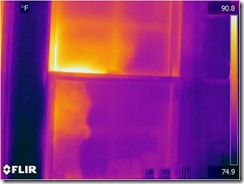
Picture1 Picture2

There was some expected infiltration around the front door which was missing a sweep on the bottom of the door. Also infiltration was found at the attic access.
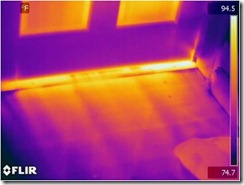
Picture3 Picture4

All of these small problems are easily correctable and will be done as time permits.

The installation of the blower door took approximately 30-45 minutes. Reaching the right depressurization took another 30 minutes and the IR scan took another 45 minutes. For a house this size, allowing for the small footprint I did not do an air exchange calculation. The purpose of this exercise was to determine if the house remodel and adding insulation was sufficient to keep the house at a comfortable level during East Tennessee summers and winters. It was determined during the remodel process that R-13 insulation in the walls and R-19 insulation in the ceilings would be sufficient for the weather conditions in this area of the country.

Friday, February 20, 2015

Warm Feet, Cold Reality

Matt Schwoegler, Infrared Training Center

It can take being uncomfortable for some homeowners to really start thinking about the efficiency of their house. Certainly, the bill from the electric company or that propane truck *once again* backing into the driveway all serve as painful reminders that your home uses (too much) energy. However, when air leakage across the floor leaves you with cold feet, or you find yourself always shivering from a draft on a windy day, it starts to get old...fast. Experiences like this can help motivate one to consider putting energy efficiency improvements on the fast track.

This assumes, of course, that the occupants are *feeling* cold in the first place. How about when it might not be as obvious, such as the case here? Sometimes thermal imaging can help a homeowner understand why what they are experiencing (feeling) is very different from what is actually happening.

FLIR1009

FLIR1006

These infrared images (above) were taken near the rim joist in the basement of a contemporary-style home built in 1984.  The residence has wood floors, fiberglass insulation and, not surprisingly, a decent amount of air leakage (3550 CFM 50).

As expected, one of the larger areas of air infiltration in the structure is located around the rim joist. What you will notice too is that the home also has a radiant floor heating system (images below):

Wednesday, October 15, 2014

Using IR With a Blower Door

Free White Paper – Click Here to Download

vics-blowerdoor-thumbThermal imaging has become an invaluable tool in the specialized field of energy auditing and building diagnostics. By itself, an infrared camera only tells half the story. The use of a blower door in conjunction with a thermal imager can help you locate areas of air infiltration throughout the building envelope that are not necessarily going to be detected under the natural stack effect.

This complimentary paper, originally presented at InfraMation 2009, explains how working with a blower door helps building thermographers get better, and more consistent, results in the field.

To learn more about InfraMation 2015 (and possibly submit a paper presentation of your own for consideration), please visit www.inframation.org

Friday, October 10, 2014

Best of InfraMation Live Webcast: Cold Air in Boston

Thursday, December 18thcold-air-boston-sawyer-IR-thumb-jpeg

2:00 p.m. EST (-5 UTC)

Guest Presenter – Dave Sawyer

Click Here for FREE Registration

Originally presented at InfraMation 2010, Dave Sawyer of Sawyer Infrared returns for a special live webinar to present his paper from the conference proceedings. It features two case studies involving clients of his from the Boston area who dealt with building performance issues.

One was an upscale restaurant experiencing cold air infiltration that was caused patron discomfort and increasing heating costs for the owners. The other, a large grocery store, was concerned that a number of freezers situated outside the building might be losing precious cold air. In both instances, thermal imaging revealed problems that would not have been detected with other test methods.

To register for this and other free live webcasts from ITC, please visit: www.infraredtraining.com/webinars