Infrared Training Center

Showing posts with label thermometer. Show all posts

Thursday, October 12, 2017

Use of the Wedge Method for Emissivity and Reflection Independent Temperature Measurement

By: Ralph Rudolph
R. Rudolph Consulting LLC @
www.temperatureconsultant.com
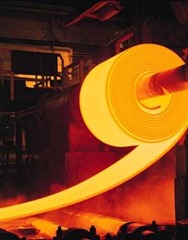
clip_image002A technique called the Wedge Method or Roll Nip method is finding increased use in measuring strip temperatures in the metal production/processing industries as it is touted as providing the dual advantages of appearing to be independent of the material emissivity and the presence of any ambient reflected radiation. Basically, the concept is quite simple: Picture a horizontal steel strip that contacts and at least partially wraps around a large roll, usually a deflector roll used to change strip direction or a bridle roll used to set strip tension. Aim a radiation thermometer almost parallel to the strip into the gap formed between the roll and strip tangent point, as deep as you can go. (Viewing at an angle from the side is fine). This gap, as the claims state, can be treated as a blackbody with an emissivity of 1.0 (see Figure 1). Hence, you don’t have to worry about ambient radiation as reflectivity is 0.0 and you don’t have to worry about changing material emissivity. This is partly true and partly wishful thinking.

Blackbody conditions exist for a cavity if and only if all sides of the cavity are at the same temperature. If the roll being used has a very low thermal mass (heats up easily) and there is a large wrap around the roll and sufficient strip tension to allow heat transfer to occur between the strip and the roll, then the roll will heat up to near strip temperature over a time period, but because the roll has natural convection, conduction and radiation losses, the roll can never quite reach the strip temperature. Emissivity never reaches 1.0. It should be obvious that if the strip abruptly changes temperature, which can happen with strip thickness or furnace temperature changes, it will take time for the roll to change temperatures. Heat transfer between the two can take quite a while during which time the temperature reading from the wedge system will be quite inaccurate.
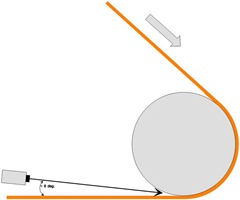
Wedge or cavity measurement method
Figure 1.

So, if a system is designed well, with a major roll wrap, low thermal mass roll, sufficient strip tension and steady long term operation (no major changes in strip temperature), this method can work as claimed (except that emissivity must be set somewhat lower than 1.0 to compensate for the roll being at a slightly lower temperature than the strip).

Given human nature, however, I’ve seen numerous instances where folks have not understood why the wedge method can work and who have misapplied it. Believe it or not, I’ve seen an instance where a so-called wedge method has been applied with zero roll wrap, with the strip simply passing over a support roll. And this system was (unfortunately) designed by the equipment provider who should have known better. I would guess that a majority of wedge method applications that I’ve seen have been poorly designed, with little attention paid to the amount of roll wrap or roll material and with little understanding of what occurs during changes in strip temperature.

There is a modification to the wedge method that can provide a significant improvement: Mount a second Radiation Thermometer to monitor roll temperature and compare this reading to that of the wedge RT. Using a PC with input and output cards (and most any older PC will work), abrupt deviations between the two readings which occur as strip temperature changes can be used to correct for errors. If accuracy is desired, it’s well worth the extra expense. You get what you pay for.

Thursday, October 11, 2012

FLIR Educational Discount Program

Educational Discount Program LogoPut the Power of Thermal Imaging in Your Students’ Hands!

A FLIR i7 thermal imager is one of the most powerful and flexible diagnostics tools a tradesman can carry today. And there’s a high demand from students eager to learn about this vital technology. That’s why FLIR is offering educators a 60% discount, making it incredibly affordable to add one to your program.

With an i7, you’ll be providing students an opportunity to discover the amazing ways thermal imaging finds problems that are normally invisible so they can readily see where to make repairs to save the day. This is cutting-edge technology that will go a long way to enhance their skills and help them gain a distinct advantage in today’s workplace.

Numerous Applications – Find hidden air leaks, missing insulation, moisture intrusion, electrical overloading, mechanical wear, and other thermal anomalies to help reduce energy waste, downtime, and safety hazards.

i7 60% offBeats IR Thermometers Hands Down – Get thousands of temperature measurements in every thermal image to show you the whole scene instead of working blind with only one spot reading at a time.

Exceeds RESNET Requirements – FLIR i7’s 140 × 140 detector delivers 19,600 pixels of IR resolution to capture the temperature measurements necessary to complete the thermal picture.

Compact Point-and-Shoot Simplicity – Light at 13 ounces (365g) for easy, one-handed operation yet tough enough to take a 2 meter drop and stow with other tools. Plus a focus-free lens and bright LCD to help you see the whole thermal scene clearly and cover more ground efficiently.

Camera & Training Support – Along with the i7, we’ll provide a DVD with downloadable guidebooks and videos plus plenty of help from FLIR and the Infrared Training Center to get you up and running. ITC also offers continuing education opportunities for your students as through online and classroom camera and thermography training courses.

For more information and to register for the program, use the link below: http://www.flir.com/thermography/americas/us/view/?id=57407

* Available to certified educators for classroom teaching at vocational and technical schools only, subject to approval by FLIR.