
Infrared Training Center

Showing posts with label reflection. Show all posts
Showing posts with label reflection. Show all posts
Friday, December 8, 2017
What the Heck is Emissivity? (part 1)


Thursday, October 26, 2017
Windshield Glass Reflections - How to Remove Them
by Bernie Lyon, Gary Orlove, and Jason Gagnon
"I do a lot of windshield defrost testing at different temps. And I wonder is there any way that can keep from having the camera and myself reflected back into the images."
Glass is about 15% reflective in the 8-12 micrometer waveband. If you are directly facing the windshield, you will inevitably get a reflection of yourself and the camera. I'm sure you have seen this.
One option is to change the angle at which you are observing the windshield, see the image below. If you are at point A, you and the camera will be reflected. If you are at point B, the camera will reflect whatever is above the vehicle, represented by C.

If there are hot objects or objects with temperature variations above the vehicle, that might make things worse. They will reflect off of the glass. If possible, you could place a high emissivity piece of material above the windshield so that all reflections off of the glass are uniform. A large piece of cardboard or a blanket might do well.
This way, you will observe only temperature changes, not patterns due to non-uniform reflections.
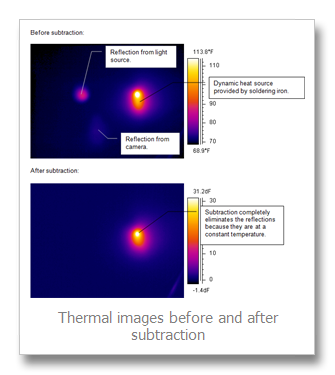
Another option is to use image subtraction techniques (you will have to have software which supports this, such as FLIR ThermaCAM Researcher).
- Take an image before running the defroster.
- Then save images as you normally would.
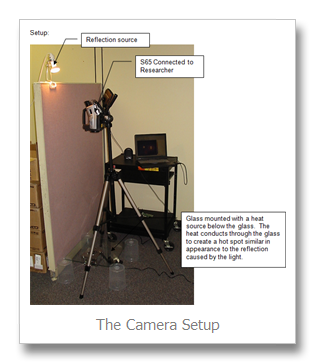
- Subtract the first image from the succeeding ones. The resulting image will show only changes in temperature and the reflections will have been eliminated. See the series of images below:

Thursday, October 12, 2017
Use of the Wedge Method for Emissivity and Reflection Independent Temperature Measurement
By: Ralph Rudolph
R. Rudolph Consulting LLC @ www.temperatureconsultant.com
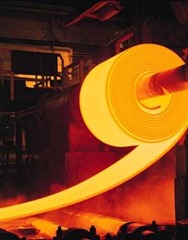
Blackbody conditions exist for a cavity if and only if all sides of the cavity are at the same temperature. If the roll being used has a very low thermal mass (heats up easily) and there is a large wrap around the roll and sufficient strip tension to allow heat transfer to occur between the strip and the roll, then the roll will heat up to near strip temperature over a time period, but because the roll has natural convection, conduction and radiation losses, the roll can never quite reach the strip temperature. Emissivity never reaches 1.0. It should be obvious that if the strip abruptly changes temperature, which can happen with strip thickness or furnace temperature changes, it will take time for the roll to change temperatures. Heat transfer between the two can take quite a while during which time the temperature reading from the wedge system will be quite inaccurate.
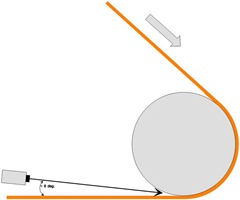
Figure 1.
So, if a system is designed well, with a major roll wrap, low thermal mass roll, sufficient strip tension and steady long term operation (no major changes in strip temperature), this method can work as claimed (except that emissivity must be set somewhat lower than 1.0 to compensate for the roll being at a slightly lower temperature than the strip).
Given human nature, however, I’ve seen numerous instances where folks have not understood why the wedge method can work and who have misapplied it. Believe it or not, I’ve seen an instance where a so-called wedge method has been applied with zero roll wrap, with the strip simply passing over a support roll. And this system was (unfortunately) designed by the equipment provider who should have known better. I would guess that a majority of wedge method applications that I’ve seen have been poorly designed, with little attention paid to the amount of roll wrap or roll material and with little understanding of what occurs during changes in strip temperature.
There is a modification to the wedge method that can provide a significant improvement: Mount a second Radiation Thermometer to monitor roll temperature and compare this reading to that of the wedge RT. Using a PC with input and output cards (and most any older PC will work), abrupt deviations between the two readings which occur as strip temperature changes can be used to correct for errors. If accuracy is desired, it’s well worth the extra expense. You get what you pay for.
Tuesday, August 12, 2014
New Online Course - Reflected Apparent Temperature Made Simple
Give us 10 minutes, and we will help you understand the term Reflected Temperature, a key parameter needed for accurate measurement as well as thermal image interpretation.
At the conclusion of this course, learners will be able to:
At the conclusion of this course, learners will be able to:
- Define Reflected Apparent Temperature (Treflected)
- Describe why its important
- Explain how Treflected is measured
- Demonstrate how the parameter is entered into an infrared camera
- Select the correct Treflected measurement method for several scenarios
Monday, January 18, 2010
The Magic of IR - Transparency

Friday, August 1, 2008
Wavelength Choice when working Outdoors
Here is a question we get from time to time at the Infrared Training Center.
"Am I correct in thinking that the solar reflections only become a problem when using shortwave IR equipment that detects the reflective IR spectrum below 3 micrometers? That is, would solar reflections be seen at all using equipment that, say, detects 5-20 micrometers?"Unfortunately no. The sun is a powerful infrared radiator and emits energy in all IR wavebands. However, the relative amount the sun emits reduces as the wavelength increases, just as Planck's law says it should. So, as we move out to longer wavelengths the amount of energy that reflects from the sun compared to the energy emitted by our targets gets smaller. This means that IR cameras that view in the longer wavelengths would be "bothered" less by solar reflections or artifacts. So the LW (8-13 µm) IR cameras see the least amount of reflected solar energy. This makes surveys easier for the operator as the true "hot spots" are easier to find.
Subscribe to:
Posts (Atom)