Infrared Training Center

Showing posts with label insulation. Show all posts

Thursday, September 7, 2017

IR finds Yellow Jackets Nest in House

by Sanin Mulic, Barber Foods

After attending my level one instruction during the week, and ITC wetting my appetite for thermal imaging, I returned home with my company's P-65 camera.  I decided to scan my own house to practice what I was taught all week.  All looked good until I went upstairs and noticed a bright spot on the inside wall.  I took several images of the spot and come Monday, I talked to two level 2 associates about what I had found.  There were several possibilities and I was told to take several more shots at different times to see if it moved or varied in temperature.   When we found it never moved I suggested that it might be insects (wasps, hornets, etc.) and talked with one of the other thermographers who would bring in a stethoscope to see if  I could hear them before opening up the wall.
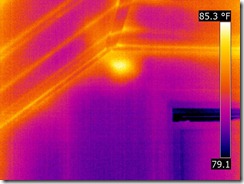
Wasps  Wasps-vis 
Thermal image of the wasp nest (left).

I couldn’t wait, so that night armed with a drill, a can of flying insect killer, and the enthusiasm of a new thermographer,  I went up to the room; my pet cat, who loves to lay in the window there, had to investigate with me too.   I approximated where the hotspot was and drilled a 1/8 “ hole through the wall board. As I removed the drill bit, about 8 to 10 yellow jackets came charging through the hole and I started to spray the bug spray at the hole.  By this time, the yellow jackets were in an attack mode and I started to swing at them in defense.  Out of the corner of my eye I saw my cat speeding to the door with his tail bigger than I have ever seen it.  I finally killed the last one, sprayed about 1/3 of the can, and plugged the hole; but not before being stung twice.  I went outside and saw a swarm just outside the window. I drilled a second hole a few inches above it and knowing what was going to follow,  I had the spray ready to go as soon as the drill came out.  I sprayed about 1/3 of the can and then plugged the hole. I returned several hours later and the swarm was gone.  I climbed a ladder and found a small hole where they were coming and going.  I plugged that from the outside.  As I came back inside I saw my cat peaking from around the door as if to ask “Is it safe to come out now?”

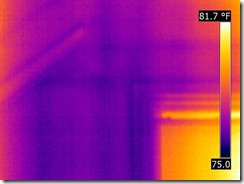
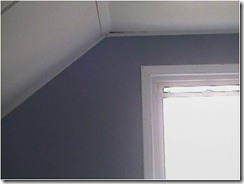
After a few days I took another thermal image and there was no evidence of the yellow jackets remaining.  I submitted this investigation as my level one field report and it passed, but the memory of this initial experience will last a long time (the cat won’t forget it either!)
No-wasps no-wasps-vis
No wasps after removal.

Wednesday, April 29, 2015

All About the Timing: Insulation Inspections and Solar Loading

Matt Schwoegler, Infrared Training Center

The effects of the Sun on the surface of a building can make inspections quite challenging for thermographers looking for missing insulation.  The transient conditions created by solar loading not only mask infrared patterns on the exterior, it also impacts the thermal signature on the interior, perhaps leading one to believe (in the right conditions) that a wall appears to be uninsulated, when in fact it is insulated. 

To capture this, I recently set-up an infrared camera at home to monitor thermal changes on a south facing wall from the interior. The plan was to image the pattern reversal that occurs on an interior surface when the Sun heats the exterior up to a point where the direction of heat flow in the wall reverses, even though the air temperature remains colder outside.

FLIR0239I programmed the camera to record an image every 15 minutes starting at 7:00 a.m. Conditions at the time were ideal to check for insulation problems in a wood-frame building given the interior air temperature of 68˚F (20˚C) and an exterior air temperature of 33˚F (0.5˚C). The first image taken, seen here on the right, shows a wall which appears to be mostly well insulated (warm cavities and cooler framing). As the day progressed, however, the situation changed dramatically.

Monday, April 13, 2015

ThermalSpeak – building efficiency and thermal bridging

by Jay Bowen
BPI Energy Analyst
ASNT NDT Level 3 Thermographer

Building conversations in training this week brought up the subject of thermal bridging in the structure. Defined by a material of less insulation or greater conductivity. This material bridges or short circuits the better insulation and reduces its effectiveness. This reduces the overall R value rating of the whole assembly. The following website,  http://web.ornl.gov/sci/roofs+walls/AWT/home.htm , addresses this whole wall rating concept. This isn’t a debate of test methods or approaches. It is enough to say that anything put in the wall that reduces the energy of that wall should be addressed in the construction process.

My input on this subject is finding these, before construction begins and discussion with a builder, methods to reduce or eliminate these bridges. Verification of the design or confirmation as building progresses would be where a thermographer can enter the process and provide proof that the building project has conformed to this concept of design.

The images from a qualified thermographer provide detailed analysis of construction detail typically hidden from the inspectors or builders.

Taking a set of images to compare this approach can clearly see the advantage of reducing the vertical framing typical of stick built construction. Even the wide wall of 2x6 framing to increase the side wall dimensions for increased insulation. This is an increase in the R value but the thermal bypass of the stud is still there.

Jay1

jay2

Using SIP to reduce bridging

Standard stick frame wall

Looking at a SIP wall can visualize the reduction in the bypasses by reducing the vertical framing. The corners and joints are still present but can be reduced by the same methods of stick built using exterior insulated sheathing.

Making the bridge elimination or reduction a conscious thought in the whole building process can have substantial rewards in energy saving in the home.

Friday, October 10, 2014

Best of InfraMation Live Webcast: Cold Air in Boston

Thursday, December 18thcold-air-boston-sawyer-IR-thumb-jpeg

2:00 p.m. EST (-5 UTC)

Guest Presenter – Dave Sawyer

Click Here for FREE Registration

Originally presented at InfraMation 2010, Dave Sawyer of Sawyer Infrared returns for a special live webinar to present his paper from the conference proceedings. It features two case studies involving clients of his from the Boston area who dealt with building performance issues.

One was an upscale restaurant experiencing cold air infiltration that was caused patron discomfort and increasing heating costs for the owners. The other, a large grocery store, was concerned that a number of freezers situated outside the building might be losing precious cold air. In both instances, thermal imaging revealed problems that would not have been detected with other test methods.

To register for this and other free live webcasts from ITC, please visit: www.infraredtraining.com/webinars

Wednesday, January 4, 2012

Analyzing Building Images Acquired at Different Times

A camera user writes:

"I find that images taken of the same structure, not much separated in time, sometimes look very different.  This poses a problem for me as I’m trying to compare the heat images of different houses (to detect homes that need weatherization).  Presently I’m not confident that images of two homes reflect actual differences in the structures, or are caused by minor environmental changes or even by artifacts in the photography.  Here is an example.

Attached are two nighttime images of the front of my house, which faces east.  IR0310 was taken at 10:40 PM, IR0408 at 11:11 PM. (The clock on the camera is two hours fast.)  It was a cold night with little temperature change over the half hour between pictures.  The house thermostat was constant. 

I've set the palette and temperature range to give me good differentiation of houses along the street.  I took the first image of my house as I began imaging houses on my street, and I took the second image when I finished the street scan. 

I am surprised, first, that my house looks so different in the two images. And second, that the outside looks warmer in the later image.  If anything, I'd have expected the outside to have cooled.

Glad for any interpretation of this.  Needless to say, with this kind of variation on a single house, it is hard to get good images for comparing houses. "

Wednesday, May 26, 2010

Can I Inspect Stud Walls when the Weather is Warm?


"Am I right in thinking that the weather/ delta T are not in my favor for stud wall analysis during the summer?"


This is a question many new thermographers have. If you think about the heat transfer, the answer is you should be able to get good images from an external wall providing you have sufficient Delta T.  

Right now it is hot outside.  So, if you are observing the exterior wall of an air conditioned residence, you should have a Delta T of 10°C or 18°F or better, if the interior temperature is about 70°F and the exterior is about 88°F or more.  Remember that the air temperature does not necessarily have to be 88°F, if the sun is heating the wall (and has been for a few hours), that will work too. If the building does not have air conditioning and the windows are all open, this would certainly make things more difficult.

Here is an infrared image of an exterior wall taken during a hot day (taken from the interior of the building). Notice the hot studs (vs. the cold studs you would see during the heating season).


You can learn more about this application in the Building IR Basics course.

Monday, May 24, 2010

Wire Insulation Temperature Limits

The temperature rating of a wire or cable is generally the maximum safe temperature that the wire can carry full-load power without the cable insulation melting, oxidizing, or self-igniting. A full-load wire does heat up due to the metallic resistance of the wire. The table below illustrates the maximum absolute temperature that different insulation types can withstand.

Note: Electrical equipment should be serviced and inspected only by qualified personnel. No responsibility is assumed by the Infrared Training Center for any consequences arising out of the use of this material. This document is not intended as an instruction manual for untrained persons.

Wire Conductor Ampacity to Temperature Rating
Maximum Operating Temperature (ref. NEC table 310-16)
Insulation Types
Insulation Types
Insulation Types
60°C (140°F)
75°C (167°F)
90°C (194°F)


 TW, UF
 FEPW, RH, RHW,
TBS, SA, SIS, FEP,

THHW, THW, THWN,
FEPB, MI, RHH,

XHHW, USE, ZW
RHW-2, THHN,


THHW, THW-2,


THWN-2, USE-2,


XHH, XHHW,


XHHW-2, ZW-2