Infrared Training Center

Showing posts with label thermography. Show all posts

Saturday, October 10, 2020

Online Certification Training Has Arrived

ITC’s new Online Thermography Certification program places you front-and-center in a virtual classroom which means you no longer have to travel to get certified. That’s because online training eliminates secondary costs typically associated with traditional in-person courses including transportation, hotel, meals and more.  All of this while offering you the most flexible and convenient certification options to date.

Pre-COVID-19, all Infrared Training Center (ITC) thermography certification courses were held at hotels, conference centers, or customer facilities. During a typical week, the ITC team could be conducting a dozen or so of these classes globally.  Then, seemingly overnight, the coronavirus pandemic forced ITC to find an alternative way to deliver classes.  

Enter online certification training.

What makes ITC’s online training program unique? It features live, interactive instruction through Zoom teleconferencing.  This isn’t just voice-over-PowerPoint where you’re learning by yourself, isolated from your instructor and your peers.  Participants can interact with both ITC trainers and their fellow thermographers in real-time, just as you can in a typical face-to-face training class.  And while there is some self-directed content, most of the class is delivered live with engaging demonstrations, group discussions, and more. Overseas ITC still maintains a face-to-face component for labs and exams. These classroom sessions, of course, meet all local COVID-regulations and safety protocols.

The response has been overwhelmingly positive and has taken off with Level I and Level II thermography classes which continue to sell out.  As such ITC has been adding dates through March of 2021 and is now in the process of expanding their online portfolio of certification training into more specialized instructional areas this fall. Coming soon, look for online sUAS and OGI thermography training as well in this new format. 

“Our business has always been about live classroom training and we don’t see that going away anytime soon,” says John Keane, ITC Global Director.  “However, the pandemic has necessitated this transition to offer more of our training library online and I see both being an important part of what we do going forward.  Besides the obvious benefits of social distancing, removing the cost of travel which, for some customers, has historically been a barrier, this now allows them to get certified too.”  

Registering for online training is easy with numerous dates and locations available that will accommodate even the busiest of schedules.  And it’s not just for individuals.  For those with larger groups which need training, these online courses are available as an onsite option too.  Contact ITC for a quote to schedule a private class exclusively for your employees that’s tailored to your individual training and certification needs.

Contact ITC to learn more about online certification training.

North America
1-866-FLIR-911
info@infraredtraining.com

Europe, Middle East, Africa
+49 (69) 95009011
info@irtraining.eu

Wednesday, February 28, 2018

FLIR ONE Online Training

FLIR ONE Basics
This course will introduce you to the operation of the FLIR ONE and FLIR ONE Pro infrared camera. This course is a self paced on-demand web course, you can start as soon as you enroll and you can stop and continue where you left off at any time. There is NO CHARGE for this course.

Tuesday, February 27, 2018

IR Consultant Pricing Survey - U.S.

One of the most frequently asked questions we get from our students and readers is "How much do consultants charge for IR inspection services?"

This groundbreaking survey provides you with the answers. The results of this survey should prove invaluable to you for both pricing and marketing your services.

We will be updating this information with a new survey to be conducted later this year. The results will be published as part of the InfraMation 2018 Conference Proceedings which all attendees receive.

If you want to be included in the survey, make sure that you opt in to "ITC email" on the Online Training registration page or your profile (for current online learners). Participants will be able to purchase the published report at a 50% discount.

Link to the Report Page

Friday, January 26, 2018

Lens Choice for Looking Through IR Windows

by Gary Orlove
More and more organizations are installing IR windows or sight glasses in their electrical equipment so inspections can be made with an infrared camera.
The advantages are obvious: worker safety is improved as thermographers and electricians don't have to open live electrical cabinets, and inspection times can be reduced.
However, what lens choice is the best to use with your infrared camera to provide adequate resolution, and yet see as much of the electrical equipment as possible?
Here are three images that were taken at a power plant looking at an ISO phase buss. The buss is only about a foot away and is taken looking through an infrared window (crystal type).
25 deg.
45 deg.
90 deg.
Images courtesy - John Fricot, FLIR Systems
As you can plainly see, the 90° lens is clearly the way to go.  It provides enough detail for analysis, yet extends your field of view by a huge amount.

Wednesday, January 17, 2018

How the temperature of your nose shows how much strain you are under

Researchers at the University of Nottingham's Institute for Aerospace Technology (IAT), together with academic staff from the Bioengineering and Human Factors Research Groups, have demonstrated that facial temperatures, which can be easily measured using a non-invasive thermal camera, are strongly correlated to mental workload.

It was found that the effect is most pronounced above the sinuses around the nose, and that facial temperatures were reduced as participants carried out tasks of increasing difficulty.

The results show that when people are fully focused on a task, their breathing rate changes as the autonomic nervous system takes over. There may also be a diversion of blood flow from the face to the cerebral cortex as the mental demand increases, although this is the subject of further research.

Read the entire article

Thursday, January 4, 2018

Cost Avoidance/Energy Savings for IR Thermography

"Has anyone documented Cost Avoidance Or Potential energy savings using Thermography. Ex. Downtime, Labor, Materials. I would be interested in understanding how you determined final cost or energy savings."

This is the $64,000 question, how to justify the cost and benefits of an IR program. The methods used vary depending on your situation, what downtime costs in your facility, overtime and rush ordering to get new parts, lost production cost, your energy cost, etc.

I have selected several white papers that illustrate how different organizations have calculated their costs. Use them as examples of what can be done, and how they are presented.

Use this link to download the files.

Wednesday, December 20, 2017

InfraMation 2018 - Call for Papers and Abstracts

inframation2018-logoInfraMation 2018 will be held in Austin, Texas, September 11-14, 2018 and we are thrilled to be heading to the "Live Music Capital of the World". Austin is known for its vibrant buzzing energy, never-ending entertainment options, and stunning outdoor settings. One thing is for sure, we will be ready to paint the town InfraRED! Join other thermal imaging experts to learn the latest thermal imaging techniques and applications, and make valuable connections!

Hilton Austin has been chosen as the InfraMation 2018 host hotel. Hilton Austin is situated right in downtown Austin, TX, just a quick walk from exclusive shopping, amazing restaurants, and a multitude of live music venues on 6th Street and the surrounding area. InfraMation attendees receive a deeply discounted rate of $199/night plus taxes. Based on availability, this incredible rate can be extended 3 days post or prior if you'd like to stay a bit longer!

Submit your abstract through this simple online form.

Benefits & Requirements - Why should you present at InfraMation 2018?
  • Qualify for a deeply discounted conference registration fee
  • Identify yourself as an infrared thermal imaging expert in your field
  • Earn valuable certification renewal credit
  • Further validate your expertise for clients and customers
  • Expand your professional and business referral network
  • Represent your organization on a big stage
Publish your paper on a searchable CD that every InfraMation attendee receives. InfraMation is the leading infrared training experience in the world. As thermal imaging becomes more mainstream, early adopters such as yourself will be sought out for your extensive know how and experience. Simply put: InfraMation is the place to get recognized! The only "hard" requirements are that your paper be non-commercial in nature (for sponsorship or exhibition opportunities, click here) and submitted in English. Abstract approval is based on clarity, suitability, and technical merit of work.

Suggested Topic Areas
  • Buildings
    • Roofing Systems
    • Water Ingress / Moisture / Remediation / Mold Testing
    • Insulation / Air Leakage / Energy Loss
    • Standards & Certification
    • Pest Detection and Control
  • Condition Monitoring
    • Electrical Distribution - Indoor, Outdoor, Transmission, Distribution
    • Mechanical Applications - Bearings, Gearboxes, Conveyors, Steam,
    • Hydraulic
    • Standards & Certification
    • Petrochemical Applications
  • Business
    • Marketing/Sales/Pricing
    • Program Management / Cost Avoidance / Cost Saving
    • Safety
  • Research & Science Applications
  • Medical/Veterinary Applications
  • Optical Gas Imaging Applications
  • IR Report Preparation Techniques
  • Aerial Drone and UAV Applications / Techniques
  • Public Safety
  • Non-Destructive Testing - Material flaws, voids, etc.
  • Alternative / other Applications / Other Technologies


What the heck is Emissivity? (Part 2)


Fill up two soda cans with hot water and wrap one in scotch tape. Which one will cool down faster? Obvious, right? Check it out, you might be surprised!


Infrared Training Center

Friday, December 8, 2017

What the Heck is Emissivity? (part 1)


Fill two soda cans with hot water and wrap one with scotch tape. Which one will radiate more heat? You might be surprised at the answer! Watch the video to find out why.


Thursday, November 16, 2017

It is Not Always about Loose Contacts

by Ahmed Osman Mohamed Hamoudy
Electrical PM & PdM Engineer
Cemex, Egypt

In modern industries, there are many predictive maintenance techniques that can be utilized to avoid an unexpected failure. At CEMEX,  we count on those techniques and deploy them in such a way as to get the most use from it, and avoid any undesirable consequences. IR thermography's use has become widespread in cement plants; application areas typically include rotating kilns, insulation, mechanical, and electrical systems.

This article will explore the uses of IR thermography, specifically as part of the Motor Control Center systems predictive maintenance routine, including typical electrical panel failure points (contactor, terminations, feeding breaker, fuses, cables, etc...).

clip_image002
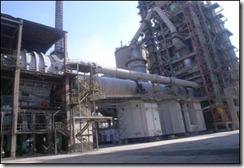
Figure 1. Rotary Kiln

One of the Clinker Rotary Kilns (4,500 Tons per Day) is supposed to be available for operation not less than a year, which is a challenge of course, to guarantee continuous operation for the kiln system for this time without any unexpected shutdown.

Monday, November 13, 2017

Emissivity and Reflected Temperature

What should I enter for my emissivity and reflected temperature values?
First, ask yourself how are you using your thermal imager?  Is it to identify thermal patterns or measure temperatures?  If you are simply trying to locate thermal patterns such as missing insulation or air leakage in a building (what is called qualitative thermography) measuring an exact temperature really isn’t necessary.  In these situations, leave the values at their default settings (typically 0.95 for emissivity and 68F/20C for reflected temperature) and go for it.

If you need to measure an exact temperature of a motor or a bearing (what is called quantitative thermography) then correctly setting emissivity and reflected temperature is a must to get the most accurate reading.  Doing so, however, should only be attempted by properly trained and certified thermographers…those who are the most qualified to measure temperatures with an infrared camera.

Thermography Certification Dates and Locations


What Is the Best Approach Until Then?
We recommend using the following basic guideline for taking simple measurements.  Know there are many other factors you will need to consider which are covered thoroughly in all ITC training classes.  Until then, to get started, let’s first define emissivity and reflected temperature.

What is Emissivity?
Emissivity is how efficiently an object radiates heat.  It’s defined as the ratio of infrared energy emitted by the object, compared to that emitted by an ideal blackbody, if both are at the same temperature.  It is represented as either a percent or a decimal.

Surfaces exhibit emissivity values ranging anywhere from 0.01 to 0.99.  A highly polished metallic surface such as copper or aluminum are often below 0.10 and are practically an infrared mirror.  Heavily oxidized metallic surfaces will have a much higher emissivity (0.6 or greater depending on the surface condition and the amount of oxidation).  Most flat-finish paints are around 0.90 (in long-wave infrared) while human skin and water are about 0.98.

What is Reflected Temperature?
Reflected temperature (also known as background temperature or Treflected) is any thermal radiation originating from other objects that reflects off the target you are measuring.  To properly obtain an accurate surface temperature reading with thermal imaging, this value (along with that of emissivity) must be quantified and programmed into the camera’s “Object Parameters” (or corresponding software if processing a saved image).  This is used so that the software can compensate for, and ignore, the effects of this radiation as it does not relate to the actual surface temperature of the object you are measuring.

For higher emissivity objects, reflected temperature has less influence.  For lower emissivity objects, however, it’s a critical factor that *must be* understood carefully!   As emissivity decreases, what you are measuring (and seeing thermally) is coming more from the surfaces of surrounding objects (including the camera and operator), not the target you are inspecting.

How to Take a Basic Temperature Measurement
The easiest way to get an accurate measurement is to modify the surface with a material that has a high, known, and consistent emissivity value.  Standard electrical tape, with its emissivity of .95, is one such item that works well for this purpose.

If the surface is safe to touch, simply adhere a piece of electrical tape to that object and set the camera’s emissivity value to 0.95.  Next set the reflected temperature to an appropriate value for the environment.  A stable, room temperature environment will provide the best results.  If you’re still unsure what that value might be, we strongly suggest a minimum of Level I Certification training to understand this concept further.

Next, measure the temperature of the tape with the camera’s spot meter or other measurement tool, being sure that the spot meter’s circle (called the reticle) is filled completely by the target.  IMPORTANT SAFETY NOTE: This “tape method” should *only be utilized* on stationary surfaces that can be accessed safely and are okay to touch.  If attempting this type of measurement on an electrical component, the circuit *must* first be shut off and locked-out/tagged-out before proceeding.

What About Measuring Emissivity and Reflected Temperature on Other Surface Types?
For other surface types, or if temperature measurement accuracy on a variety of other objects is important for you and your inspection program, a minimum of a Level I Thermography Certification Training course is required.   Level I will teach you how to correctly adjust emissivity and reflected temperature on a variety of other components including those that are electrically energized or are difficult to access.  Attendees will learn about the proper procedures needed to evaluate both to ensure thermographers are getting the most accurate temperature readings with their thermal imager.

To learn more about these certification classes, as well as upcoming training dates and locations, please visit the Infrared Training Center online at http://www.infraredtraining.com

Thursday, October 26, 2017

Windshield Glass Reflections - How to Remove Them

by Bernie Lyon, Gary Orlove, and Jason Gagnon

"I do a lot of windshield defrost testing at different temps. And I wonder is there any way that can keep from having the camera and myself reflected back into the images."

Glass is about 15% reflective in the 8-12 micrometer waveband. If you are directly facing the windshield, you will inevitably get a reflection of yourself and the camera. I'm sure you have seen this.

One option is to change the angle at which you are observing the windshield, see the image below. If you are at point A, you and the camera will be reflected. If you are at point B, the camera will reflect whatever is above the vehicle, represented by C.

image

If there are hot objects or objects with temperature variations above the vehicle, that might make things worse. They will reflect off of the glass. If possible, you could place a high emissivity piece of material above the windshield so that all reflections off of the glass are uniform. A large piece of cardboard or a blanket might do well.

This way, you will observe only temperature changes, not patterns due to non-uniform reflections.

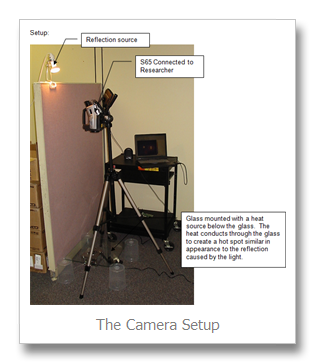
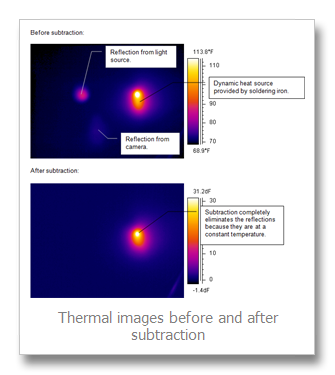
Another option is to use image subtraction techniques (you will have to have software which supports this, such as FLIR ThermaCAM Researcher).

  1. Take an image before running the defroster.
  2. Then save images as you normally would.
  3. Subtract the first image from the succeeding ones. The resulting image will show only changes in temperature and the reflections will have been eliminated. See the series of images below:

Wednesday, September 20, 2017

Blower Door Inspection for Air Infiltration in a Remodeled Cottage

By Tom Coffey, Infrared Training Center 

ITC logo registeredA small cottage (700 sq. ft) outside of Knoxville, TN was completely remodeled from January to March 2010. It was an existing cinder block structure with no insulation except ½ inch of airspace between the nailers and the block wall as well as the empty block core. The R value of existing building walls was approximately 2.97. After the remodel an R-value was calculated and determined to be 12.6

2 x 4 studs were used to build the interior walls the insulated with 4” of backed fiberglass bat insulation. Old windows were removed and new double pane sash type windows installed during the remodel.

The house was depressurized to approximately 50 Pascal and allowed to equalize for 30 minutes. A thermographic scan was performed after the equalization period. Infiltration was found around the sash windows where the top and bottom pieces join in the corners of the windows.

Picture1 Picture2

There was some expected infiltration around the front door which was missing a sweep on the bottom of the door. Also infiltration was found at the attic access.

Picture3 Picture4

All of these small problems are easily correctable and will be done as time permits.

The installation of the blower door took approximately 30-45 minutes. Reaching the right depressurization took another 30 minutes and the IR scan took another 45 minutes. For a house this size, allowing for the small footprint I did not do an air exchange calculation. The purpose of this exercise was to determine if the house remodel and adding insulation was sufficient to keep the house at a comfortable level during East Tennessee summers and winters. It was determined during the remodel process that R-13 insulation in the walls and R-19 insulation in the ceilings would be sufficient for the weather conditions in this area of the country.

Wednesday, September 13, 2017

Getting Started with R&D Thermography Online Course

ITC logo registeredVideo tutorials on IR Camera Properties and getting started with ResearchIR. For any SC camera including A300, A320, SC645, SC6000, SC6700, and SC7000, SC8000 cameras.  There is NO CHARGE for this FREE  course.

Includes information on:
  • Camera Technology
    • Cooled vs Uncooled Thermal Cameras: Field of View
    • The difference between cooled & uncooled thermal detectors?
    • Cooled vs Uncooled Thermal Cameras: Speed
    • Cooled vs Uncooled: Sensitivity
  • FLIR ResearchIR Max
    • Connecting to the Camera
    • Image Enhancement
    • Image Subtraction
    • Recording Data
    • Triggering
    • Super Framing
    • Analysis Tools
    • Analysis Charts
    • Measurement Functions
    • Sharing Data
    • File Extraction Tool
  • FLIR ResearchIR and MATLAB
    • FLIR Thermal Face Detection and Tracking in Matlab
    • Opening FLIR Movies with Matlab Software
    • Connecting FLIR Systems GigE Cameras to MATLAB
    • Applying MATLAB Filters in FLIR ResearchIR Max Software
   Course Registration and Information

Thursday, September 7, 2017

IR finds Yellow Jackets Nest in House

by Sanin Mulic, Barber Foods

After attending my level one instruction during the week, and ITC wetting my appetite for thermal imaging, I returned home with my company's P-65 camera.  I decided to scan my own house to practice what I was taught all week.  All looked good until I went upstairs and noticed a bright spot on the inside wall.  I took several images of the spot and come Monday, I talked to two level 2 associates about what I had found.  There were several possibilities and I was told to take several more shots at different times to see if it moved or varied in temperature.   When we found it never moved I suggested that it might be insects (wasps, hornets, etc.) and talked with one of the other thermographers who would bring in a stethoscope to see if  I could hear them before opening up the wall.

Wasps  Wasps-vis 
Thermal image of the wasp nest (left).

I couldn’t wait, so that night armed with a drill, a can of flying insect killer, and the enthusiasm of a new thermographer,  I went up to the room; my pet cat, who loves to lay in the window there, had to investigate with me too.   I approximated where the hotspot was and drilled a 1/8 “ hole through the wall board. As I removed the drill bit, about 8 to 10 yellow jackets came charging through the hole and I started to spray the bug spray at the hole.  By this time, the yellow jackets were in an attack mode and I started to swing at them in defense.  Out of the corner of my eye I saw my cat speeding to the door with his tail bigger than I have ever seen it.  I finally killed the last one, sprayed about 1/3 of the can, and plugged the hole; but not before being stung twice.  I went outside and saw a swarm just outside the window. I drilled a second hole a few inches above it and knowing what was going to follow,  I had the spray ready to go as soon as the drill came out.  I sprayed about 1/3 of the can and then plugged the hole. I returned several hours later and the swarm was gone.  I climbed a ladder and found a small hole where they were coming and going.  I plugged that from the outside.  As I came back inside I saw my cat peaking from around the door as if to ask “Is it safe to come out now?”

After a few days I took another thermal image and there was no evidence of the yellow jackets remaining.  I submitted this investigation as my level one field report and it passed, but the memory of this initial experience will last a long time (the cat won’t forget it either!)

No-wasps no-wasps-vis
No wasps after removal.

Tuesday, August 29, 2017

Why does my Infrared Camera read higher than my Infrared Temperature Gun?

 ITC Logo TM 250 The answer is, in a word, resolution. Take a look at the image below.

7-20-2010 1-48-44 PM

The infrared camera is able to locate and measure much smaller objects than an IR temperature gun. Note the spot measurement on the infrared image; its reading is 250 F. Contrast that to the average area measurement typical of an infrared gun at a reading of 184 F. The gun is averaging all the hot areas along with the cold areas of the grating we see in the image.

Another common question is why the IR camera reads a higher temperature than a contact temperature probe? Contact temperature probes require an extremely good contact in order to read a decent temperature. In fact these probes measure their own temperature, so if the heat transfer is not good from the substrate, and the probe sensor is colder than the surface, the temperature will be lower. Also remember that contact thermometers act as heat sinks, sucking heat out of a surface.

Wednesday, August 23, 2017

IR Pictures Through a Grating or Mesh

Question from a customer: “Scanning through the steel grating I read a temperature 5 to 15 degrees Celsius lower than scanning without the grating. I know it is to do with the steel grating but I was wondering why.”
Great question. Let’s take a look at a typical situation with and without a grating, and then placing the grating at different distances to the camera.
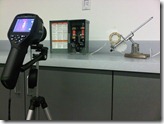
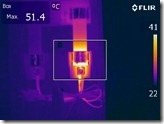
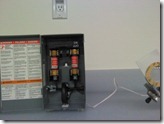
The distance between the fuse and the camera remains constant, and the camera is always focused on the fuse. The only changes are the insertion of the grating, and the distance of the grating from the infrared camera.
IMG00077-20120215-1115IR_0001DC_0002
Figure 1. Looking at a fuse directly with no grating. Max temperature is 51.4 C.
IMG00078-20120215-1116IR_0003DC_0004
Figure 2. We have inserted the grating close to the fuse.
Max temperature dropped to 51 C, a small error.

Friday, August 18, 2017

What does Sensitivity (NETD) mean when applied to a Thermal Imager?

Sensitivity expresses the ability of an infrared camera to display a very good image even if the thermal contrast in a scene is low. Put another way, a camera with good sensitivity can distinguish objects in a scene that have very little temperature difference between them.
Sensitivity is most often measured by a parameter called Noise Equivalent Temperature Difference or NETD, for example, NETD @ 30 C : 80mK. A Kelvin degree is the SI base unit of thermodynamic temperature equal in magnitude to a degree Celsius, so mK means thousandths of a degree (80mK = 0.080 K).
What is NETD? NETD is defined as the amount of infrared radiation required to produce an output signal equal to the systems own noise. This is a noise rating of the system and should be as low as possible. We are not talking about how loud the system is here!!! We are talking about electronic noise that we translate into a temperature difference at an object temperature of 30 C (86 F).

Wednesday, January 4, 2017

New Online Course - Introduction to FAA Part 107 Small Unmanned Aircraft Systems

The FAA has developed regulations to allow the operation of small unmanned aircraft systems (sUAS or drone) in the National Airspace System (NAS) for purposes other than hobby and recreation. The rules are specified in 14 CFR part 107 and address UAS classification, certification, and operating rules.

This course is designed to introduce applicants wishing to operate a sUAS for commercial purposes to Part 107 knowledge. In addition, we include an infrared thermography primer for those wishing to use airborne thermography as an inspection tool.

Course Structure
This course can be taken on a computer, tablet, or a smartphone. For the best experience, we suggest a device with a larger screen for easier readability. It will take approximately 1.25 hours to complete this material.

At the conclusion of each lesson, there will be a knowledge check followed by a lesson summary.

At the conclusion of the course, you may then print a course completion certificate. Presenting this certificate when registering for an instructor led Level I sUAS Certification Course will entitle you to a discount equal to the purchase price of this online course.

Learn More

Monday, October 17, 2016

InfraMation 2016 – a World Class Training Event

Nearly 450 attendees, presenters, exhibitors, and staff congregated at the Rio Hotel and Resort in Las Vegas, Nevada for InfraMation 2016 in late September.

Attendees listen to a speaker in the General Session Auditorium
The event included 54 presenters, 23 clinic short courses, and 31 paper presentations on a wide variety of thermal imaging applications ranging from bats (the flying kind) to bridges to buildings.There was a lot of buzz and interest in the new field of unmanned aerial vehicles. Jan Gasparic from DJI gave one of the keynote presentations and it was very well received. Bill Schwann, an ITC instructor, managed a clinic on IR UAV applications that was standing room only and very popular. In addition, there were several exhibitors demonstrating this technology.

Corbett Lundsford gave Keynote and clinic presentations on Build Performance Testing and how Proof of Performance is Possible; while Casey Anderson, our wildlife expert, was also back and gave another amazing Keynote presentation on mountain lion behavior at night.

Corbett Lundsford answers questions during his Keynote presentation
The conference had a good mix of first time attendees and returning delegates from previous conferences, providing a dynamic mix of experienced and new thermographers exchanging ideas, information, and experiences.

With over 87% of attendees rating the conference Very Good or Excellent, I think this quote from one of the ITC staff sums up the conference experience:

"The last day in Las Vegas, a gentleman came up to me almost in tears. He said he had never been so impressed with a conference in all his life. He said the speeches, classes and workshops were great. He gained lots of knowledge and had all of his questions answered with lots of “Ah Ha” moments. He especially liked the lineup of speakers."
Joe DeMonte captivates the audience at the Mechanical Applications Clinic