Infrared Training Center

Showing posts with label thermal camera. Show all posts

Thursday, November 16, 2017

It is Not Always about Loose Contacts

by Ahmed Osman Mohamed Hamoudy
Electrical PM & PdM Engineer
Cemex, Egypt

In modern industries, there are many predictive maintenance techniques that can be utilized to avoid an unexpected failure. At CEMEX,  we count on those techniques and deploy them in such a way as to get the most use from it, and avoid any undesirable consequences. IR thermography's use has become widespread in cement plants; application areas typically include rotating kilns, insulation, mechanical, and electrical systems.

This article will explore the uses of IR thermography, specifically as part of the Motor Control Center systems predictive maintenance routine, including typical electrical panel failure points (contactor, terminations, feeding breaker, fuses, cables, etc...).

clip_image002
Figure 1. Rotary Kiln

One of the Clinker Rotary Kilns (4,500 Tons per Day) is supposed to be available for operation not less than a year, which is a challenge of course, to guarantee continuous operation for the kiln system for this time without any unexpected shutdown.

Thursday, October 26, 2017

Windshield Glass Reflections - How to Remove Them

by Bernie Lyon, Gary Orlove, and Jason Gagnon

"I do a lot of windshield defrost testing at different temps. And I wonder is there any way that can keep from having the camera and myself reflected back into the images."

Glass is about 15% reflective in the 8-12 micrometer waveband. If you are directly facing the windshield, you will inevitably get a reflection of yourself and the camera. I'm sure you have seen this.

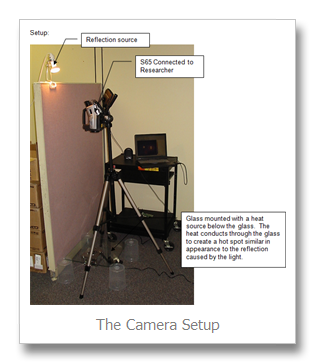
One option is to change the angle at which you are observing the windshield, see the image below. If you are at point A, you and the camera will be reflected. If you are at point B, the camera will reflect whatever is above the vehicle, represented by C.

image

If there are hot objects or objects with temperature variations above the vehicle, that might make things worse. They will reflect off of the glass. If possible, you could place a high emissivity piece of material above the windshield so that all reflections off of the glass are uniform. A large piece of cardboard or a blanket might do well.

This way, you will observe only temperature changes, not patterns due to non-uniform reflections.

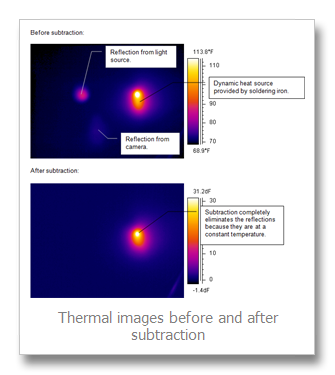
Another option is to use image subtraction techniques (you will have to have software which supports this, such as FLIR ThermaCAM Researcher).

  1. Take an image before running the defroster.
  2. Then save images as you normally would.
  3. Subtract the first image from the succeeding ones. The resulting image will show only changes in temperature and the reflections will have been eliminated. See the series of images below:

Wednesday, June 29, 2016

Traveling? Bring Extra Towels (and an Infrared Camera Too)

Ron Lucier, ASNT NDT Level III – TIR
Sr. Instructor – ITC

Time to call Housekeeping and ask for more towels.
For much of the year ITC instructors are on the road running certification classes at a variety of locations, including a number of onsite courses that are less expensive and more convenient for customers.  We look forward to these trips as there are many fun and interesting places to go and teach.  The hotels where we stay for these types of classes, however, can sometimes deliver unexpected surprises as happened to me recently at an onsite course in central Pennsylvania.

When I made my reservation it was with a major chain and within a mile of the customer site – perfect!  No traffic jams to deal with and a shopping center with restaurants a mile away.  It was expensive, but this is summer and with a major amusement park 20 miles away, and in the middle of Penn Dutch country, well, best to grin and bear it!

I drove from Central Massachusetts arriving just before a huge thunderstorm.  I wasn’t in my first floor room for more than 5 minutes when the rain suddenly hit, hard!  It was during this torrential downpour that I began to hear something rather odd – water dripping.  Looking around the room the source of the noise was the window and it wasn’t simply dripping – it was pouring in right near the air conditioner!  I shut the unit off because I know electricity and water probably shouldn’t mix.  I immediately called the Front Desk and was told Maintenance would be around soon.

Wednesday, March 16, 2016

Why Would I Need a Mid-Wave Infrared Camera?


We are often asked this question in our infrared certification classes.  There are a number of important reasons...to detect certain gasses including methane, to better measure the temperature of glass (it has a high emissivity, >.90 in MWIR) and to minimize reflections when inspecting certain low-slope roof membranes.

It also allows us to successfully inspect inside a furnace because mid-wave cameras can see clearly through flame at specific mid-IR wavelengths, something that a long-wave imaging system does not provide due to the radiation transmission properties of fire.  This capability improves the accuracy of temperature readings and allows for better analysis of thermal patterns when evaluating the efficiency of burners, capturing the temperatures of tubes or detecting the build-up of coking.

Check out this short video clip from last year's InfraMation conference which nicely demonstrates the transmission differences between long-wave and mid-wave cameras when inspecting furnace tubes:


The presenter, Andy Whitcher, is actually returning to this year's conference in Las Vegas to speak about Optical Gas Imaging this time around.  More on that in another post.  For now, enjoy this video and then make plans to join us at the Rio Las Vegas in September for InfraMation2016; the industry’s largest thermal imaging applications and networking conference.  I hope to see you there! 

Monday, November 2, 2015

The Shadow Man Cometh

By Ronald Lucier, ASNT NDT Level III, Infrared Training Center

When I use the term “Radiation Heat Transfer” in my classes I sometimes get puzzled or even frightened looks as some folks associate the term radiation to Chernobyl and atomic weapons. It takes only a few minutes and a couple demonstrations to put them at ease though.

One of the simpler demonstrations is done outdoors on a sunny, warm day. It is common knowledge that the Sun is HOT – roughly 6000 ˚C or 10800 ˚F. Happily the Inverse Square Law and our atmosphere attenuate the thermal radiation to livable levels here on Earth!

But it is still thermal radiation! What happens if we interrupt that radiation? A simple experiment is to take a thermal camera into a safe area, like a parking lot, and create your own shadow!

I did this in the middle of my street the other day. Fortunately we don’t get much traffic, usually only the postman drives by and that’s to turn around and deliver mail.

Setting my camera up (a FLIR T650sc) to record a radiometric .csq file, I started recording and walked into the scene and made a shadow. The change in roadway temperature WAS INSTANTANEOUS! After 30 plus years in the business we sometimes get surprised and I was! Look at the raw plot data, ignore the spikes and where I walked into the scene:

fig 1

The two spots started out at the same temperature. Just look at the table data.

Time (sec)

Roadway

Shadow

Difference

0:00

98.2

98.3

0.1

9.37

98.9

98.5

-0.5

14.77

99.1

97.7

-1.4

22.2

99.4

97.2

-2.2

29.8

99.7

97.1

-2.6

50.13

99.9

96.1

-3.8

61.6

100.0

95.5

-4.5

67.3

100.0

95.4

-4.6

All temperatures are in degrees Fahrenheit.I stopped taking data at 67 seconds as it was indeed a partly cloudy day and the clouds came by. Here are my start, middle and end jpegs:

image image image

Engineers love graphs so I can’t resist! I took five seconds of data and drew a trend line through both sets to show that the roadway wasn’t cooling, just the shadow.

image

This doesn’t require a high end camera such as the FLIR T650sc – any IR camera, a little Sun, an absorbing surface such as a sidewalk or even a wall will suffice.

The best way to learn is to teach! I encourage all the readers of this article to go teach your friends, co-workers and family a little bit about radiation heat transfer!

Wednesday, January 21, 2015

Keynote Presentations Announced for InfraMation 2015

The InfraMation conference, the world’s leading IR training experience, is pleased to announce that Brent Bushnell, CEO of Two Bit Circus, a Los Angeles-based experiential entertainment company and Terrance O’Hanlon, CMRP and Publisher of Reliabilityweb.com®, RELIABILITY® Magazine and Uptime® Magazine, will be leading Keynote Presentations at this year’s event in Nashville, Tennessee May 11-14, 2015.
www.inframation.org
brent-bushnell
Brent Bushnell and the team at Two Bit Circus recently launched STEAM Carnival, a modern re-imagining of the midway to inspire kids about science, technology, engineering, art and math. Previously, Brent was the on-camera inventor for the ABC TV show Extreme Makeover: Home Edition and was a founding member of Syyn Labs, a creative collective combining art and engineering for large brands including Google & Disney. In his spare time, Brent mentors teens in game development and entrepreneurship via programs such as Spark and the Network for Teaching Entrepreneurship.

Terrence-OHanlonTerrence O'Hanlon, is also the acting Executive Director of the Association for Maintenance Professionals and the Executive Editor and Publisher of the 5th Edition of the Asset Management Handbook. A voting member of the US TAG (PC251) for ISO 55000 - ASTM E53 Asset Management Standards Committee, Mr. O'Hanlon more recently was selected as the sole US Representation through ANSI for ISO Working Group 39 to create a standard for competence in assessing and certifying Asset Management programs known as ISO 17021-5. He is also a member of the Institute of Asset Management, American Society of Mechanical Engineers, The Association of Facilities Engineers, Society of Maintenance and Reliability Professionals and the Society of Tribologists and Lubrication Engineers.

www.inframation.org/keynotes/

Tuesday, January 13, 2015

New Live Webcast Schedule Available

Infrared_EdITC’s successful series of free, live webinars, continues into 2015 with a number of new topics and dates that have been added to the schedule.  We've added steaming video from our production studio for most presentations and have improved the audio quality to deliver a better overall broadcast of the live webinars. On-demand sessions also available:

http://www.infraredtraining.com/webinars

These complimentary educational webinars are designed to provide a valuable overview of thermal imaging and its many applications. Participants learn not only the basics of infrared thermography, but also where IR can reduce costs, save energy and increase safety for professionals across a variety of industries. Attending these sessions also demonstrates why pursuing a professional certification in thermography is a necessary step to becoming a successful thermographer.

If you’re in the electrical, maintenance, or home inspection business, infrared thermography can help you spot a number of issues that your eyes simply can’t see.  Join us for one, or perhaps all, of these webcasts today to learn more!

Registration is now available at www.infraredtraining.com/webinars where you’ll also find a number of on-demand recordings from past live events that can be viewed at any time.

Wednesday, October 15, 2014

Using IR With a Blower Door

Free White Paper – Click Here to Download

vics-blowerdoor-thumbThermal imaging has become an invaluable tool in the specialized field of energy auditing and building diagnostics. By itself, an infrared camera only tells half the story. The use of a blower door in conjunction with a thermal imager can help you locate areas of air infiltration throughout the building envelope that are not necessarily going to be detected under the natural stack effect.

This complimentary paper, originally presented at InfraMation 2009, explains how working with a blower door helps building thermographers get better, and more consistent, results in the field.

To learn more about InfraMation 2015 (and possibly submit a paper presentation of your own for consideration), please visit www.inframation.org

Friday, October 10, 2014

Best of InfraMation Live Webcast: Cold Air in Boston

Thursday, December 18thcold-air-boston-sawyer-IR-thumb-jpeg

2:00 p.m. EST (-5 UTC)

Guest Presenter – Dave Sawyer

Click Here for FREE Registration

Originally presented at InfraMation 2010, Dave Sawyer of Sawyer Infrared returns for a special live webinar to present his paper from the conference proceedings. It features two case studies involving clients of his from the Boston area who dealt with building performance issues.

One was an upscale restaurant experiencing cold air infiltration that was caused patron discomfort and increasing heating costs for the owners. The other, a large grocery store, was concerned that a number of freezers situated outside the building might be losing precious cold air. In both instances, thermal imaging revealed problems that would not have been detected with other test methods.

To register for this and other free live webcasts from ITC, please visit: www.infraredtraining.com/webinars

Friday, September 12, 2014

An ITC Hot Spot: Focus (Video)

In a previous ITC Hot Spot we discussed the impact that Thermal Capacitance has on thermographers.  Now, this first video in a series of segments that we’re producing on image quality, we address focus and how it can negatively affect our ability to discern important thermal details and measure accurate temperatures if not adjusted properly:

Tuesday, July 8, 2014

IR on Electric Motors: Great for the Plant…and at Home Too!

It’s no secret that infrared can be used to diagnose problems with electric motors in industry, but residential applications? As ITC Instructor Ron Lucier recently discovered, possibilities exist at home as well, this one involving his pool pump motor:


Returning from a recent Level III class in Nashua I heard an awful noise in my backyard when I stepped out of my car. Pretty quickly I determined it was my pool pump motor (1 horsepower). What a racket. Sounded like just a bearing so I brought out my trusty vibration acceleration detector: a screwdriver. Measuring at each bearing of the motor and the pump I didn’t feel very much. However, I noticed a black spot on the side of the gold painted motor. It was time to get out the IR camera: my brand new FLIR T650sc.

I would find out the next day that the long wave emissivity for this paint is 0.91 so making the correction the hot spot was about 201 F! Good thing that I didn’t try to touch it!

pool-pump-01-800w

Tuesday, May 27, 2014

Infrared Everywhere: Hot Chicks

After I joined the ITC team this past fall, my family and I have been caught up in the process of relocating to southern New Hampshire. Now that we’re finally settled in, and the last of the moving boxes have been emptied, I guess it was time to take on another challenge, this one involving fresh eggs. My wife has always wanted to try raising chickens, and now that we live on a small farm, what better place to take the plunge!

The little ladies arrived in the mail about five weeks ago (yes, the Post Office delivers chicks) and have been growing rapidly ever since. Here’s a quick infrared video from their first week inside the house, captured with a FLIR T650 thermal imager:

Monday, February 10, 2014

Can the FLIR One™ Personal Thermal Imager Perform Real Work?

I have seen some buzz around the internet about the FLIR One’s ability to do serious infrared work.  While it is a low resolution thermal imager, the combination of its IR imaging and FLIR’s MSX technology makes it into a useful tool.

Take a look at the following FLIR One™ images of thermal anomalies found in a house, and see if you don’t agree.

Missing Insulation 
Missing Insulation

Cold air leaking around outlet

Cold air leaking through a vent 
Cold air leaking through a vent

Drain Pipe in Wall 
Drain pipe in wall

Wednesday, October 2, 2013

MSX Explained - in Plain English

itc logo (2)Have you ever wished you could have a high fidelity thermal image, but also be able to read labels and see discrete details not shown in the thermal image?

Well now you can, with a new technology called MSX.

MSX stands for Multi Spectral Dynamic Imaging, an exclusive image enhancement technology now available on several infrared cameras. This new technology is based on a unique onboard processor that provides extraordinary thermal image details in real time. MSX incorporates real-time thermal video augmented with visible spectrum definition. It produces exceptional thermal clarity to highlight exactly where the problem is. MSX ensures easier target identification without compromising radiometric data. The quality of the thermal images is excellent. There is almost no need any more for a separate digital image; MSX embosses digital camera detail onto thermal video and stills.

How does it work?

An onboard processor continually processes the visual channel and extracts only the visual detail from the visible channel. That visual detail is then added to the thermal image information. Unlike many thermal fusion technologies, the thermal information is not diluted at all, it is just augmented with visual detail not apparent in the thermal image. The result is an incredibly robust and fully radiometric thermal image displaying details and making it easy to know what is being viewed and where problems lie. See this video.

MSX Explained

Thursday, September 13, 2012

New Online Course Released - Introduction to Thermography for Home Inspectors

Are you a home inspector interested in adding infrared thermography to your list of services? Do you already own an infrared camera and want to learn where and how it can be used for home inspections? Then this course is for you!
We start out with just enough "science" to get you into the groove, then its on to applications: why they work, how to do it, and case history examples. The course is divided into the following sections:
  • Thermography Basics
  • Moisture Investigations
  • HVAC Investigations
  • Insulation Investigations
  • Air Leakage Investigations
  • Electrical Investigations
  • Structural Investigations
  • Miscellaneous Investigations
Use this link to go to the course home page for more information.

Wednesday, May 2, 2012

IR InformIR Blog Enhancements

I have added a few enhancements blog readers should appreciate.

imageA search box has been added so you can easily search the blog for the content you are looking for.


imageThe blog can now be easily translated into one of 54 different languages, everything from Afrikaans to Yiddish. Just use the drop down menu on the right and choose your language!


imageAn easy “follow by email” tool has been added which makes it easier than ever to get new blog content sent to your email box automatically and right away.

Enjoy!

Tuesday, May 18, 2010

Live IR Imaging of Iceland Volcano

A FLIR A320 infrared camera was shipped to the Icelandic Mila company and is now installed to monitor Eyjafjallajökull volcano. The camera is installed approx. 10 kilometers away.

View live visible and infrared imagery of the volcano at the link below.

LIVE VOLCANO IR VIDEO 

Monday, January 18, 2010

The Magic of IR - Transparency


A video from David Brown of the Infrared Training Center explaining transparency in the world of infrared.